What RIBA Chartered means.

Two checks, not one. And neither includes the other.

Reviewed August 2026
The short answer

Two checks, and they are separate. Only someone on the Architects Registration Board's register may call themselves an architect, which is the law. RIBA Chartered Practice is a voluntary accreditation covering insurance, quality systems, a code and continuing training. A practice can hold one without the other.

In practice · Brackley

A care home, brief to handover

A credential reads more clearly against a building. This one ran the whole framework, from the first question about what the site could carry to the year after the doors opened.

The order of work
01Brief and feasibilityStages 0 and 1. What the allocation could carry, before anything was drawn.
02Design and consentStages 2 and 3. The scheme worked up, then varied to sixty-six beds.
03Technical and buildStages 4 and 5. Conditions discharged one at a time, then construction.
04Handover and useStages 6 and 7. Handed over, and in use since.

The site is a primary-care allocation off Turweston Road on the edge of Brackley, in a wider campus alongside a GP surgery, a pharmacy and a cottage hospital. The client was Kingsley Healthcare. The brief was sixty-six single bedroom suites over two floors, thirty-three a side, each with its own bathroom.

The job
Site
A primary-care allocation off Turweston Road, Brackley
Role
Architect, RIBA Stages 0 to 7
Client
Kingsley Healthcare
Outcome
Sixty-six single bedroom suites over two floors, built and in use

Consent for sixty-two beds came first. A section 73 variation took it to sixty-six, with revised elevations and a further parking space, and that is the permission the building was delivered under.

More

From there the work stopped being persuasive and turned technical. The conditions were discharged one application at a time: external lighting, contamination remediation, cycle parking, surface-water drainage, a travel plan, landscape maintenance. The limestone was approved against a sample panel a metre square, built on the site itself and looked at in the real light. The building went up through the pandemic and it is in use.

Stage 0 to Stage 7 is the full span a Chartered Practice is accredited to work across. Most projects never need all of it. Knowing which part of it you are buying is the useful thing.

Each of those condition discharges is a separate application with its own reference and its own decision, and each one sits on the West Northamptonshire register under this practice's name. It is the part of a track record nobody can write for themselves, because the council has already written it down.

Conditions are also where a consent quietly turns into a building or quietly does not. A permission granted on a Tuesday can still be months from a start on site, because the pre-commencement conditions attached to it have to be discharged first, each on its own timetable and each capable of holding up the work it governs.
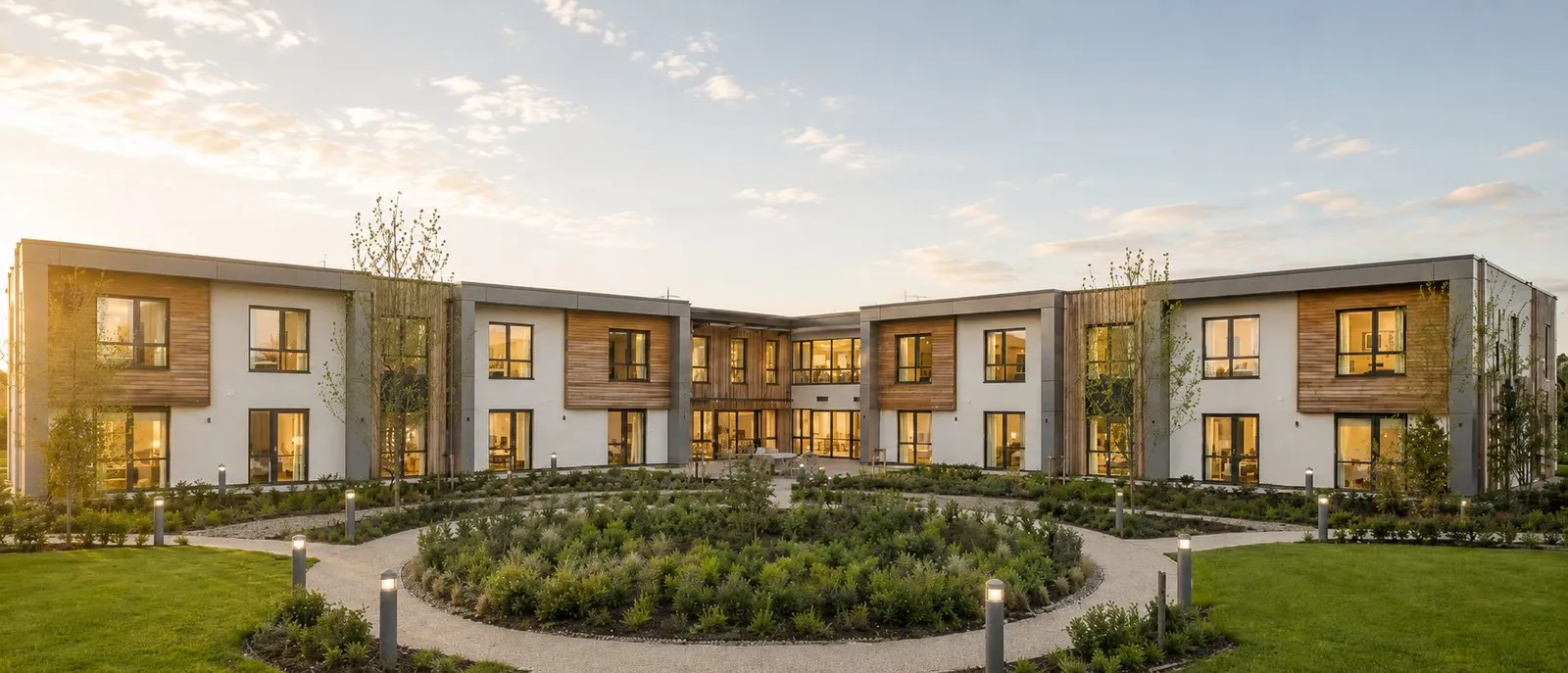
A Rickett Architects visualisation of the completed care home in soft morning light: a two-storey building in white render and vertical timber cladding wrapping three sides of a courtyard, with a circular planted sensory garden, gravel paths and lawn in front of it.
Brackley Care Home, Turweston Road. The courtyard elevation, a Rickett Architects visualisation of the completed building rather than a photograph.
The proof

Four jobs on the public record.

Stages 0 to 3 · allowed

Oakridge Lynch, Stroud

Nine homes on a paddock outside a village in the Cotswolds National Landscape, refused by the council and then allowed on appeal. Rickett Architects designed the scheme, was the named agent and led the appeal. The Inspector found no conflict with the council's own design and density policy.

Stroud District Council · allowed 21 October 2025
Stages 4 to 6 · approved

Tanners Lane, Lincoln

A stalled student scheme on a tight inner-city plot, consented by a previous team and taken on at technical design. Full technical design of both phases from scratch, then two non-material amendments and three condition discharges, all approved across nine months.

City of Lincoln Council · five approvals, 2025
Grade II · two consents

A Regency terrace

A Grade II listed Regency terrace in a Leamington Spa conservation area, half of a subdivided pair. An orangery on a listed house needs householder permission and listed building consent, and the two are argued on different tests. Both were granted.

Warwick District Council · consents granted 2024
At committee · granted

Priory Terrace

A church hall in a Leamington Spa conservation area with listed buildings on either side of it, extended at the rear. Twelve objections were lodged, so the application went to planning committee rather than being settled by an officer. It was granted there.

Warwick District Council ref W/23/1560 · granted May 2024

Every application this practice makes in its own name lands on a council register anyone can search. Across those registers sit 84 listed building consents in 16 local authorities, the earliest of them from 2001.

Architects for private homes →
The first step

Checking who you are about to appoint?

Send us your project and where it is. A Senior Architect will give you an initial appraisal and guide you as to what to do next.

Start a conversation
01 · Where you stand

First, the word the law protects

One word is regulated and the work is not. Section 20 of the Architects Act 1997 says that nobody may practise or carry on business under any name, style or title containing the word architect unless they are a registered person, and section 21 makes contravening that an offence, punishable by a fine at level 4 on the standard scale. Naval architects, landscape architects and golf-course architects are written into the Act as exceptions.

More

So anyone at all may design a building, and anyone at all may charge you for doing it. What they may not do is use the word. If the person you are talking to does not call themselves an architect, nothing on this page applies to them, and for a great many projects that is a perfectly reasonable place to be.

Registration is not a certificate collected once and framed. It is renewed annually against a fee, it binds the architect to a statutory code, and since 2024 it has carried a continuing-training obligation of its own. The Architects Registration Board can remove a name from the register, and removing the name removes the title with it. That is the statutory floor. RIBA Chartered Practice is a separate thing, and it is voluntary.

The code is the Architects Code, Standards of Professional Conduct and Practice, and the current edition took effect on 1 September 2025, replacing the 2017 one. It sets six standards: honesty and integrity, public interest, competence, professional practice, communication and collaboration, and respect. Under it an architect has to ensure their liabilities are covered by adequate and appropriate professional indemnity insurance, and that is not decorative. Architects have been disciplined for failing it.

The board's training scheme is not the same as the RIBA's and works differently. It is outcomes-based rather than counted in hours, it is built around two mandatory subjects, fire and life safety and environmental sustainability, and records are declared at each annual renewal with a sample reviewed. An architect who lets registration lapse simply disappears from the register, which is a cheaper answer than any reference.

It is also worth being clear about what the Act does not do. It does not reserve the design of buildings, or the making of a planning application, or the supervision of a site, to anybody. Those are open to all. The protection is on the word alone, which is a narrower thing than most people assume when they see it on a letterhead.

02 · The criteria

What Chartered Practice certifies

A practice applies, declares against a published list and renews every year. Four of those declarations are the ones a client can use.

Criterion 01

Chartered members on the staff

At least one full-time principal has to be a Chartered Member of the RIBA, all architectural work has to be supervised by one, and the number of Chartered Members a practice must employ rises with its size on a published band table.

What it does not mean: a Chartered Member is not automatically on the ARB register. The two are counted separately.
Criterion 02

Insurance, declared annually

Professional indemnity cover appropriate for the work the practice undertakes, in force at the point of application and not due to expire within the month. The declaration is made again at every renewal.

What it does not mean: the cover is declared, not published. Ask to see the certificate, and ask what the limit is.
Criterion 03

Systems and written policies

A quality management system in place and operational at a scale relevant to the practice, plus health and safety, employment, equality and diversity, and environmental management policies, and a written procedure for handling complaints.

What it does not mean: none of these needs external certification. There is no ISO requirement anywhere in the list.
Criterion 04

Training that has to be kept up

A system for making sure architects follow the RIBA Code of Professional Conduct and meet their training obligations. For a Chartered Member that is thirty-five hours of learning a year, at least twenty of them across ten mandatory topics.

What it does not mean: the declaration is annual and self-made. Five per cent of all practices are monitored at random.
03 · The check

How to check both in minutes

Two registers settle it, both free and both open to anyone.

The statutory one is the Architects Register, published by the Architects Registration Board at architects-register.org.uk. It can be searched by a person's name, by a company name, by registration number, or by distance from a postcode, and an entry shows the registration number, the practice, its address and any disciplinary order currently standing against that architect. If the name is not there at all, that person may not lawfully call themselves an architect, and no further conversation is needed.

More

The voluntary one is Find an Architect, the RIBA's directory of Chartered Practices. A practice that appears in it holds the accreditation. The RIBA runs a separate directory of individual Chartered Members, but that one lists only those who have agreed to appear, so absence from it proves nothing either way. Use the practice directory for the practice, and the statutory register for the people.

Neither register answers the question underneath, which is whether the practice is insured at a level that suits the size of your job. That figure is nowhere public. Ask for the certificate and ask what the limit is: the board's own guidance puts the minimum at £250,000 for each and every claim.

There is a third check worth two minutes, and it is the most useful of the three. Council planning registers are public, searchable by address, and they hold every application a practice has made in its own name, with the drawings, the officer's report and the decision attached. A practice can describe its work in whatever words it likes. The councils have already written it down in theirs.

One limitation to know before leaning on that. Applications are filed under the name of whoever acted as agent, so a scheme where the architect designed the building and a planning consultant fronted the paperwork does not appear under the architect's name at all. A council register is a floor, never a full account.

The last question is the plainest one and it belongs in the same conversation: which of the eight stages does the fee you are being quoted actually cover, and what happens at the end of the last one you have bought.

Common questions

Credentials, answered

What is a chartered architect?

An individual who is on the ARB register and is also a Chartered Member of the RIBA. The practice accreditation is a separate thing.

More

The two words do different work. Architect is the legally protected title and it comes from the statutory register. Chartered comes from the RIBA, which is a membership body operating under a Royal Charter rather than a regulator. A person can be one without the other, and the RIBA is explicit that you do not have to be a registered architect to be a RIBA Chartered Member. RIBA Chartered Practice, the thing this page is mostly about, is held by the business rather than by any one person in it.

What qualifications does an architect need?

Three qualifications and a minimum of two years of practical experience, all of which the ARB has to be satisfied of before a name goes on the register.

More

The familiar route is Part 1, Part 2 and Part 3, with the practical experience recorded along the way, and there is a separate examination route the board sets itself for people whose qualifications came from elsewhere. The route is being reformed: in May 2026 the board approved a new registration process, and it has announced a further route opening in spring 2027 that will accept an accredited Part 2 and Part 3 without a Part 1. None of that changes the endpoint. Registration is the only thing that confers the title, however the person reached it.

Does an architect have to be RIBA Chartered?

No. It is voluntary. Plenty of registered architects and good practices are not RIBA Chartered, and there is nothing improper about that.

More

Registration is the legal requirement and RIBA membership sits alongside it as a choice, with a subscription attached. What Chartered Practice status gives a client is not proof of talent, which no register can supply. It is a set of things the practice has had to declare and keep in place: insurance, a working quality management system, health and safety, employment, equality and environmental policies, a written complaints procedure, and continuing training for its members. A practice without it may have every one of those anyway. The difference is that nobody outside has been told so.

What is the RIBA Plan of Work?

The framework that splits a building project into eight stages, numbered 0 to 7, from first idea to the building in use.

More

The current version is the RIBA Plan of Work 2020 and the stages are 0 Strategic Definition, 1 Preparation and Briefing, 2 Concept Design, 3 Spatial Coordination, 4 Technical Design, 5 Manufacturing and Construction, 6 Handover and 7 Use. It matters to a client for a plain commercial reason rather than a technical one: an appointment is scoped, priced and invoiced by stage, so the stages are how you know what you have bought and where the job has got to. Most projects buy a span rather than the whole thing.

What happens if something goes wrong?

There are two routes and only one of them is statutory. A complaint about a registered architect's conduct goes to the ARB.

More

The Architects Registration Board is the statutory regulator, constituted under the Architects Act 1997. It holds registered architects to a code, it can investigate, and its Professional Conduct Committee can reprimand, fine, suspend or erase a name from the register, which takes the title with it. Its decisions are published, and a current order also shows on the architect's own entry in the public register. The RIBA runs a separate process for its own members and publishes those outcomes by name too. Neither route recovers money: a claim about the work itself is a contractual matter, which is why the insurance question is worth asking before you sign rather than after.

Does a RIBA Chartered Practice cost more?

Chartered status is not a price band. What it changes is the set of obligations the practice has to carry and keep current.

More

Fees turn on what the job is, how complicated the site is, how far through the stages you are going and whether the practice has worked for you before. None of those is a function of accreditation. The more useful question is not what a practice charges but which stages the fee covers, because a fee that takes a scheme to a planning decision and a fee that takes a building to completion are different purchases, and people routinely assume the first is the second.

Is Rickett Architects a RIBA Chartered Practice?

Yes, and its architects are on the ARB register. The practice has been working since 1970 and is listed in the RIBA's Find an Architect directory.

More

Both facts are checkable without asking us. The Architects Register carries the individuals, and Find an Architect carries the practice. Beyond the two credentials, the work itself is on the public record: every application this practice makes in its own name sits on a council planning register with its drawings attached, which is a harder thing to overstate than a line on a website.

Written by

Rickett Architects

A RIBA Chartered practice, working since 1970, with more than 2,500 projects behind it. Our senior architects take projects from first survey through planning to completion, for private clients, developers and landowners across the Midlands and well beyond it.

Tell us about your project

Checking an architect before you appoint?

A Senior Architect will reply. We will give you an initial appraisal and guide you as to what to do next.

Your enquiry will go directly to a Senior Architect.

Thank you. A Senior Architect will reply personally.
Something went wrong sending this. Please call 01926 967 090 or email studio@rickett.co.uk.