The ten per cent, settled at feasibility.
Where the gain is delivered is a layout decision, and it is far cheaper to make before anything is drawn than after consent.
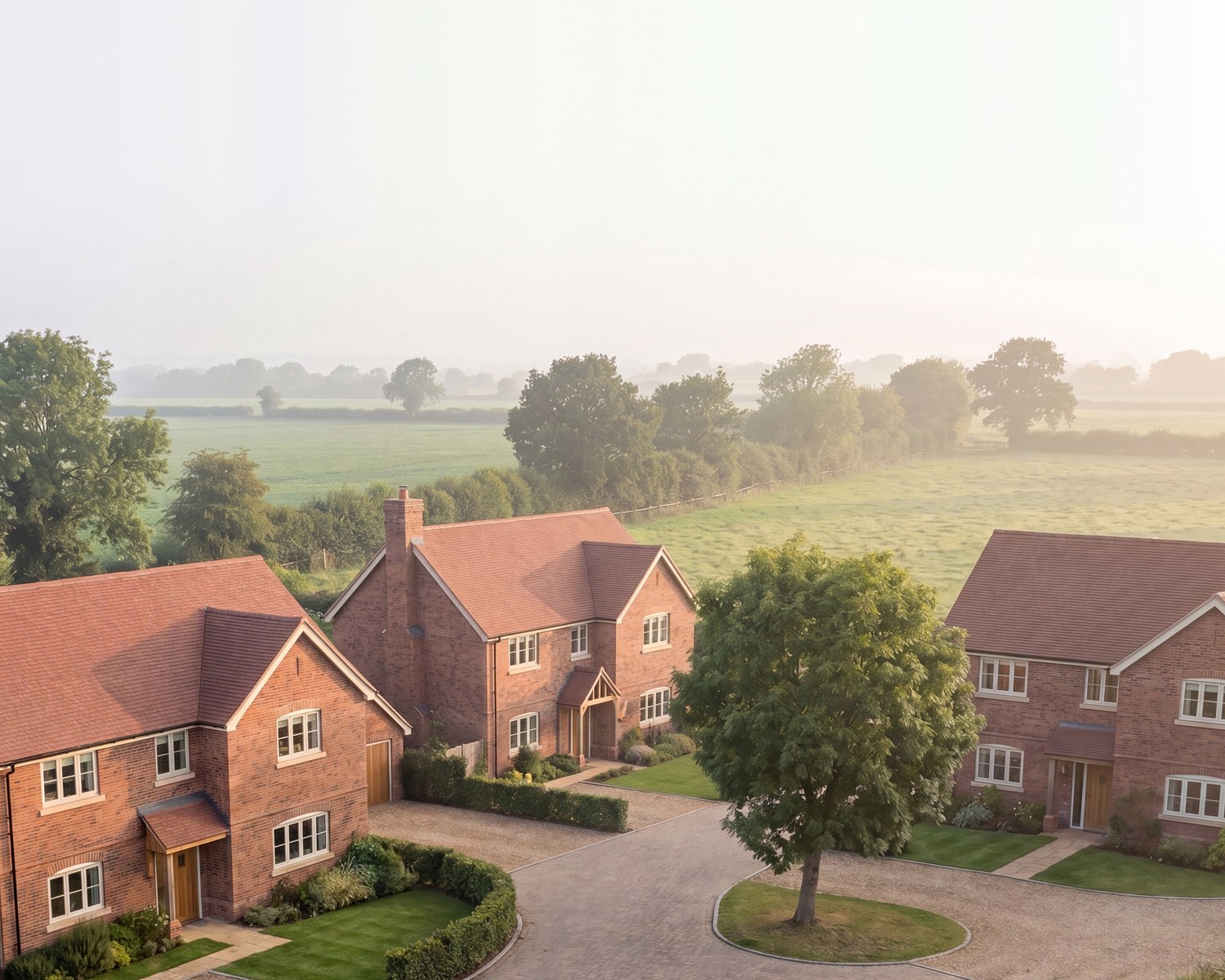
Hob Lane
Four homes on a third of a hectare, where the ten per cent could not be found on site. The agreement that secured it off site held the decision notice for four and a half months.
View project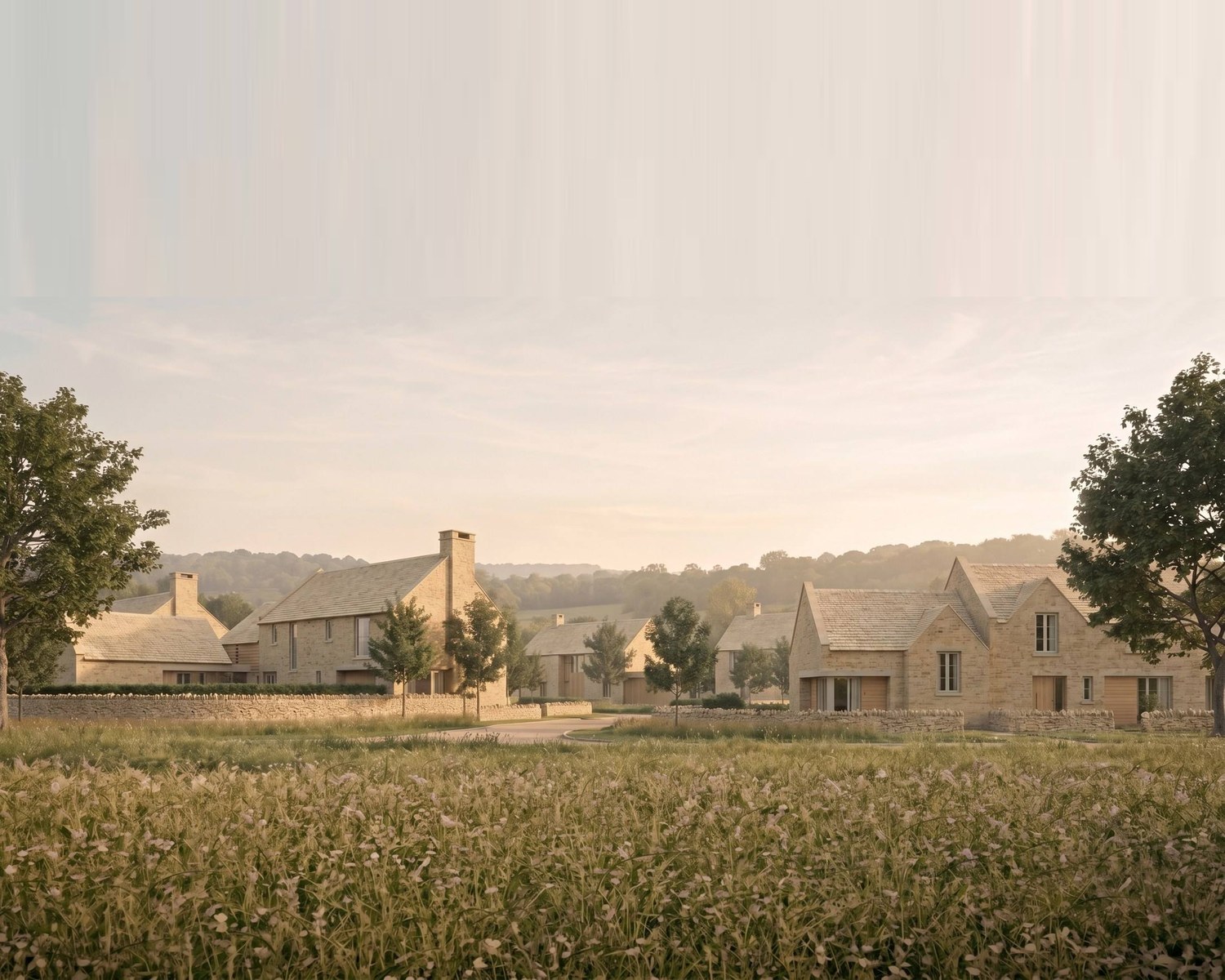
Oakridge Lynch
Nine homes refused on eight grounds, ecology among them. It was answered on evidence, not redesign, and allowed at appeal with half the site left as open meadow.
View projectBefore it is a cost, it is a layout.
 Where you stand · 01
Three ways out, one override.
Three tests take a site out of scope on size, two of them new for applications made from 6 August 2026. All three fall away the moment a priority habitat is touched, whatever the site measures.
Read more → The arithmetic · 02
The baseline writes the bill.
Two sites the same size, in the same town, carrying the same number of homes can arrive at very different net gain bills. What separates them is visible from a desk.
Read more → The routes · 03
On site until it stops paying.
Enhance what is there, create what is not, then buy registered units for the shortfall. Distance counts against that last one, which is why local is worth having.
Read more → The habitat bank · 04
Sixty-eight acres in Northamptonshire.
Wood Farm, Everdon, managed as a habitat bank for schemes that cannot deliver their gain on site.
Read more → The programme · 05
The condition comes before the spade.
The gain plan is pre-commencement, and the authority has eight weeks to determine it. On a section 106 scheme the agreement can hold the notice itself.
Read more →Won in October. Issued in February.
Wood Farm, Everdon. Sixty eight acres in Northamptonshire, managed as a habitat bank with units available through a broker. You can read more about it in The Wild Company's case study.
So a scheme that cannot carry its gain on site can buy the units elsewhere. Send us the site and what is on it, and a Senior Architect will reply and tell you plainly whether the ten per cent is a design question or a cost.
→ Start a conversation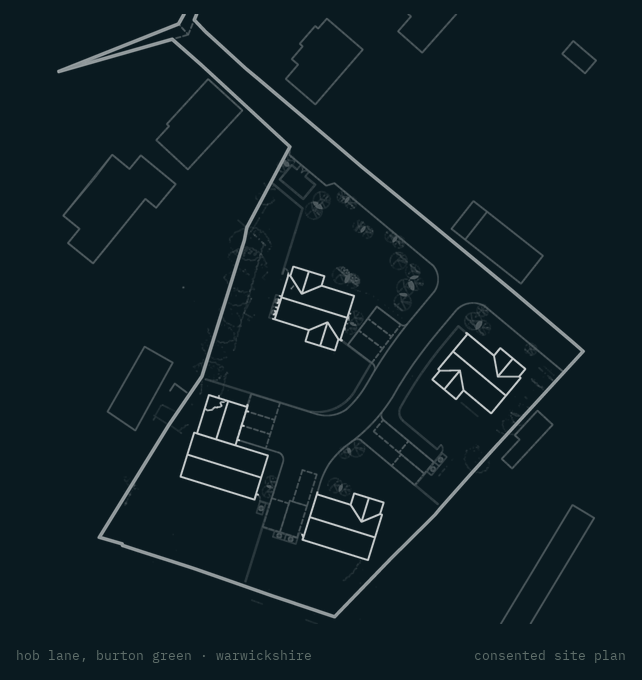
Hob Lane, Burton Green. Warwick District Council ref W/24/0454, four homes on 0.36 hectares, architect and planning agent from first sketch to consent. Granted at committee 7 October 2025, notice issued 25 February 2026 with twenty-one conditions.
More
The gain plan is still to be approved before development begins, and at 0.36 hectares the plot would still be in scope today.
Net gain became mandatory on 12 February 2024 for major development and 2 April 2024 for small sites, so most of this practice's record predates it, and none is offered here as a delivered net gain figure.
More
Ashlawn Road, Rugby was a householder scheme, which net gain does not reach: a bat roost was mitigated with the application and the ecology condition discharged twenty-three days early. At Oakridge Lynch newts were among eight grounds of refusal; they were answered on evidence, and the appeal was allowed in October 2025. Every application in the practice's own name is public record, across more than 100 planning authorities, and the practice has worked since 1970.
Three ways out, one override.
Three tests take a site out of scope on size, and the date the application was made decides which apply. A development of 0.2 hectares or less, measured to the red line, for applications made from 6 August 2026. A development touching less than twenty-five square metres of habitat and less than five metres of hedgerow, since February 2024. And a temporary permission of five years or less, also from 6 August 2026.
All three carry the same override, and it is the one that catches people out. None of them applies if the development impacts a priority habitat on site. A small site with priority habitat on it is in scope however small it is, so the habitat question has to be answered before the area question is worth asking. The area test is measured to the red line too, which means the boundary drawn on the application decides whether the scheme is in scope.
Size is not the only way out. Some development is exempt whatever it measures: householder applications, permitted development and other development granted permission by development order, and urgent Crown development. Off-site gain sites are exempt themselves, which follows once you see that their whole purpose is to carry somebody else's obligation. The full scope, and what it misses
The baseline writes the bill.
The number of units decides a feasibility more than their price, and that number is set by what is already on the ground. A site of tired grassland and a thin hedge starts from a low baseline and needs very little to clear ten per cent. A site carrying mature habitat starts high, and every unit of that baseline has to be replaced before the uplift even begins.
That makes net gain a site-selection question before it is a design question. Two sites of the same size, in the same town, carrying the same number of homes, can arrive at very different bills, and the difference is visible long before anyone commissions a layout. We would rather run that check at the offer stage than explain the number after exchange.
On site until it stops paying.
The cheapest units are usually the ones already on the site. Improving the condition of existing grassland, hedgerow or woodland scores against the same metric as making something new, and costs a fraction as much, because the habitat is already established. New planting, ponds and meadow come next, and that is where layout and net gain start arguing with each other, because land given to habitat is land not given to homes.
Where the site cannot carry the whole gain, the shortfall is bought in, and only units on the biodiversity gain sites register count towards it. Distance is one of the factors the metric weighs, alongside habitat type, size, condition and strategic significance, so units nearer the loss are worth more than units far from it. That is the practical argument for sourcing locally rather than wherever is cheapest on the day.
Sixty-eight acres in Northamptonshire.
A habitat bank is land managed for at least thirty years to generate biodiversity units, recorded on the biodiversity gain sites register, that schemes with no room of their own can buy. At Wood Farm, The Wild Company carried out the ecological survey and designed the landscape plan: species-rich grassland, hedgerow and watercourse enhancements, without changing the farm's agricultural character.
None of this changes the order of work: the gain is designed on site as far as the layout will carry it, and only the shortfall is ever bought. Where another provider suits the site better, that is the one to use.
The condition comes before the spade.
The biodiversity gain condition is pre-commencement. A gain plan sets out the baseline, the post-development value, what is delivered on site and what is bought off it. It must be submitted and approved before development starts, and the authority has eight weeks to determine it. That falls between consent and starting work, which is where an unresolved shortfall becomes a delay.
The bigger risk is further upstream. Where the shortfall goes off site on a scheme that needs a legal agreement, the agreement has to complete before the permission exists at all. At Hob Lane that took four and a half months after the committee had already voted to grant. We would rather identify the off-site source while the application is being drafted than start looking once the resolution is in hand.
Questions? Start here.
Straight answers to what developers and landowners ask first about the ten per cent.

Is biodiversity net gain mandatory for my site?
Yes, unless an exemption applies, and the date the application was made decides which rules apply. Householder applications and permitted development are exempt outright. Since February 2024, a development touching less than twenty-five square metres of habitat and less than five metres of hedgerow is out of scope. For applications made on or after 6 August 2026, a site of 0.2 hectares or less, measured to the red line, is out of scope too, and so is a temporary permission of five years or less. None of these applies where a priority habitat on the site is affected.
Read more→
How much does biodiversity net gain cost?
There is no published price for a biodiversity unit, because the off-site market is private and brokered. There is a published ceiling. Statutory credits run from forty-two thousand pounds a credit to six hundred and fifty thousand, and two are needed for every unit, so the cheapest unit bought that way costs eighty-four thousand.
Read more→
What is a habitat bank, and does the practice have an interest in one?
A habitat bank is land managed for at least thirty years to generate biodiversity units that schemes with no room of their own can buy.
Read more→
When does net gain need to be resolved?
At feasibility, and certainly before the layout is fixed. The biodiversity gain condition is pre-commencement: a gain plan has to be submitted and approved before development starts, and the authority has eight weeks to determine it. Where the shortfall goes off site, the legal agreement can hold the decision notice itself.
View the project→
Can a self-build still claim the exemption?
Only where the application was made before 6 August 2026. The regulations that came into force that day removed the self-build and custom build exemption entirely, with a transitional provision preserving it for earlier applications. A scheme carried forward on the old assumption is worth re-checking against the area test instead.
Read more→
How does net gain interact with nutrient neutrality?
They are separate regimes, and satisfying one does nothing for the other. Net gain is a biodiversity uplift under the Environment Act. Nutrient and water neutrality are catchment-based constraints that can hold a consent until mitigation is secured. A site in an affected catchment has to resolve both, and both are worth testing at feasibility.
Read more→