Not sure where your site stands?
Send us your site and what you want to do with it. A Senior Architect will give you an initial appraisal and guide you as to what to do next.
Start a conversationA practical guide for developers and landowners with an industrial estate, trade-counter unit or town-centre employment site they think could work harder in residential use.
To win residential consent on protected employment land, you have to show that employment use is no longer realistic, or that the new use outweighs the loss. That is an evidence question rather than a design one, and the test sits in the local plan, not the NPPF.
On a protected employment site, sequence is everything. Viability and the policy read come first, before the design.
We read a canalside site in Leamington Spa that way: tired industrial and trade-counter units on land the local plan protected for employment. The owners, a single joint venture, wanted to know whether it could work harder as housing.
We started with the commercials, not the architecture. Appraisals at two densities set a defensible value against a clear cost. We read the policy objection early, then designed genuinely mixed use, with employment space kept under student rooms.
Over the assessment, the council accepted the central point: employment-only redevelopment was not viable. The officers' report recommended approval.
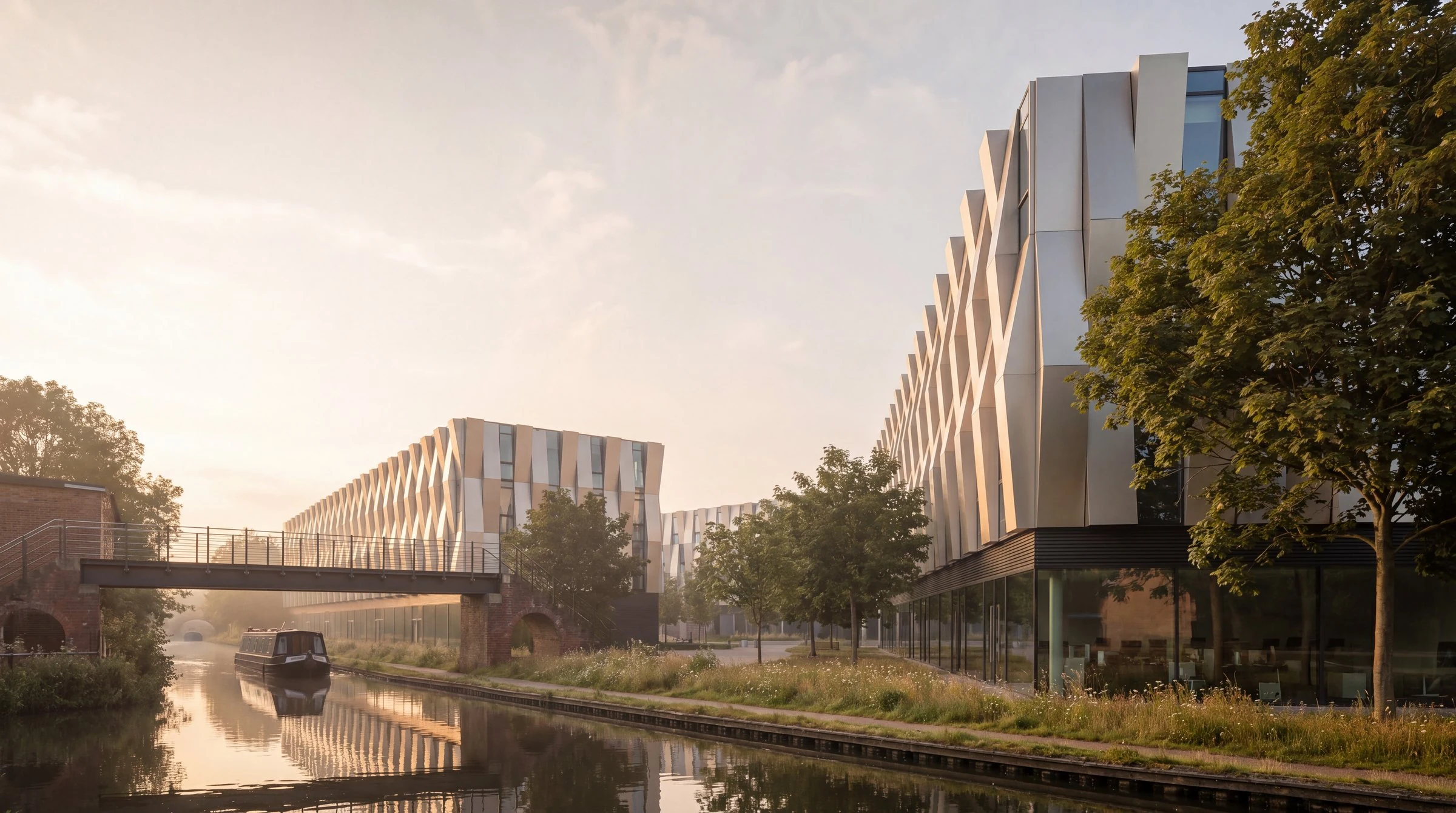
The decision was taken under delegated powers, and it went the other way. The refusal rested on policy, the protection of town-centre employment land and the council's vision for that quarter, not the viability evidence. That is the risk to price in: you can win the argument and still lose the permission.
The appraisals and the policy read came first, so the owners knew the numbers before committing serious money. Reading a site early is what makes an early decision cheap.
A pre-application does not remove that risk. It settles what policy asks and what evidence will be tested, but the advice is officer opinion and does not bind whoever signs the decision.
A tired retail block on a main road. Rather than ask the council to accept the loss of the commercial floorspace, we kept it: flexible commercial space at ground floor, with eighteen apartments above and behind. The employment objection was answered by the scheme itself, which is Route 03 above.
The upper floors of a listed building on Leamington's main parade, sitting in office use above the shops. We took them to six apartments, winning both the change of use from B1a office to C3 residential and the listed building consent that made it possible.
A run-down commercial building that already had a Class O prior approval to become flats. That route would have delivered a poor conversion, so we went for the better scheme: demolition and eight new apartments. Refused on amenity, redesigned around a rear lightwell, granted at committee. Built and sold.
Two vacant 1990s office blocks with a Class O prior approval already in place when we were appointed. We designed and delivered the conversion to sixty-four apartments for Elevate Property Group, carried five further consents through the council, and re-specified the cladding mid-build for EWS1.
Every application we make is a matter of public record on a council planning register. Ours reach more than 100 planning authorities across the UK.
Our work for developers →Send us your site and what you want to do with it. A Senior Architect will give you an initial appraisal and guide you as to what to do next.
→ Start a conversationNot every commercial site is protected. Check the local plan and the policies map: plenty of yards, units and offices carry no employment designation at all. On those, the test below does not apply.
If your site sits in a designation such as an employment area, safeguarded land or a Town Centre Employment Area, the starting position is that the floorspace stays. The rest of this page is for you.
If you have an existing building rather than open land, Class MA prior approval may get you to residential without the full test. Size limits apply, and an Article 4 direction can remove the right. It is the cheapest question to answer, so answer it first.
Where a designation applies, the reasoning is economic, not architectural. The council is protecting jobs and its employment land supply, so housing starts with a policy presumption against it.
Setting that aside is rarely about design. It takes evidence that the site is worth more to the area as something other than employment, in the way the council's policy requires.
If your site is designated, there are four ways to pass. Most successful cases combine more than one.
A genuine marketing campaign, at realistic terms, showing no occupier demand. Councils look for the right price or rent, the right channels, a suitably qualified agent such as a chartered surveyor with local knowledge, and the enquiries documented.
Where it fails: a campaign that ran too short, or was pitched at a price no occupier was ever going to pay for it.
An independent appraisal showing that employment-led redevelopment does not stack up. It is not enough to assert it: the figures have to show it, and the council will usually have them checked by an independent adviser of its own.
Where it fails: numbers softened to suit the answer. A reviewer sees it, and the whole application loses credibility.
A mixed-use scheme that retains employment floorspace, usually at ground floor with homes above. Planners call it co-location. It changes the question: instead of asking the council to accept a loss, you offer a scheme that protects employment and adds homes.
Where it fails: a token unit no business would ever take. The retained space has to be real, lettable and properly serviced.

At Althorpe Street in Leamington Spa, the worked example above, this was the form the scheme took: ground-floor retail, management and employment space under 273 student rooms, with parking in an undercroft.
Housing the area needs, the regeneration of a tired site, or the removal of a bad-neighbour use, all weighed against the employment that goes. This is the planning balance, and it is a judgement the council makes rather than a calculation you can run.
Where it fails: on its own. It turns on the weight a council gives its designation, so it works best alongside another route.
It is the evidence a council asks for before it will accept housing or another non-employment use on land protected for employment, and several authorities make it a formal validation requirement with that exact title.
In practice it sets out the case that the site has no realistic future as employment: a record of genuine marketing at realistic terms, the lack of occupier demand, and often a viability appraisal showing employment use does not stack up. Without it, an application on protected employment land is usually invalid or refused for lack of information.
You justify it on evidence, not assertion.
The council needs to be shown either that there is no realistic prospect of the site continuing in employment use, proven through a genuine marketing campaign and usually a viability appraisal, or that the benefits of the new use, such as housing the area needs or the regeneration of a tired site, outweigh the employment that is lost. A mixed-use scheme that keeps some employment can carry the argument further. Most successful cases combine more than one of these.
There is no single national figure; the period is set by the local plan and the council's validation requirements, and it varies.
Some authorities look for around twelve months of continuous, genuine marketing, others ask for twenty-four months or more, and some want part of that time to test a mixed-use offer as well. What matters as much as the length is that the marketing was real: the right price or rent, the right channels, a suitably qualified agent, and the enquiries documented. Check the specific council's requirements before you start.
Councils look for proof that the site was genuinely available and genuinely unwanted.
That means a marketing campaign run at a realistic price or rent, by a suitably qualified person such as a chartered surveyor with local market knowledge, over the period the local plan requires, with the listings, enquiries and outcomes recorded. Evidence that the units are dated or unfit for modern occupiers, and that comparable space nearby sits empty, supports the case. Thin or short marketing, or an asking price set too high, is the most common reason this evidence is rejected.
National policy supports it in principle but does not decide it.
The National Planning Policy Framework, rewritten in August 2026, keeps the same release valve: standing in the way of an allocation or safeguarding only counts against a scheme while there is a reasonable prospect of an application coming forward for the allocated use, and while the safeguarding itself remains appropriate. That provision is general, not specific to employment land, and the actual test your application must pass comes from the local plan and the council's policies, not from the Framework.
For most protected employment sites, redeveloping for housing needs a full planning application, and that is where the loss-of-employment evidence applies.
There are separate permitted-development routes that let some existing buildings, certain commercial premises under Class MA for example, change to residential through a lighter prior-approval process, subject to size limits and conditions, and councils can remove those rights with an Article 4 direction. The two routes are very different. Which one applies depends on the building, its current use class and the local position, so confirm it before you assume either.
Because they have to plan for it.
A council is required to maintain a supply of employment land and to support local jobs and business space, and protected sites are part of how it meets that obligation. Every site released to housing reduces that supply, and the council has to be satisfied the loss is justified and, where it can be, made up elsewhere. That is why the burden of proof sits with the applicant, and why a credible, well-evidenced case matters more here than on an unconstrained site.
Rickett Architects
A RIBA Chartered practice, working since 1970. Our senior architects have taken employment-land, change-of-use and mixed-use schemes through councils across the Midlands and well beyond it.
Tell us about your project
A Senior Architect will reply. We will give you an initial appraisal and guide you as to what to do next.